South Costa Rica
If Costa Rica's southern strip is known for one thing it’s the marquee lefthand pointbreak of Pavones, one of country's most celebrated waves. The region’s crown jewel is definitely worth the effort of getting there, but it isn’t the only wave on offer. With generally slimmer crowds than the central and northern zones, this is the adventurous traveler’s best option for happening upon some unpublicized surf. And while there’s a bit more distance between breaks, the southern zone is still exposed to swell from a variety of directions. Depending on the length of your trip, a little extra effort could put you into good waves with limited crowds.
The Waves

Pavones
Pavones has been called the longest left pointbreak in the world, and though Chicama in Peru probably has usurped that distinction, rides of three minutes are possible on a solid S swell -- and that's three minutes of full-on, down-the-line, zero-cutback surfing. It's the kind of wave that will expand your whole scope of riding waves -- especially if you're used to surfing beachbreaks. Your bottom turns are extended 30 yards, and top turns can last longer than some commercials. The top of the point is west of the rivermouth and acts as the main takeoff zone; as such, it's competitive. If you're lucky enough to get a wave from here, you get three or four semi-bowly sections where you can do a few carves. As you approach the rivermouth the wave speeds up and (depending on the tide) can get super-hollow, so you need to start tucking and pumping and going as fast as your surfboard will carry you. After you pass the rivermouth, the wave slows down again for a bit before tapering perfectly into the bay, as your legs give out (you've surfed almost a mile already). Then you step out onto the sand and slog back up the point for more. But it's fickle as all hell. You could sweat out a month in the middle of primo S swell season and not see a head-high wave, as the spot is tucked pretty far inside the Golfo Dulce.

Matapalo
Just south of Drake's Bay is the Osa Peninsula and the Golfo Dulce, home of Matapalo, an occasionally brilliant righthander. On the other side of Golfo Dulce is the world-class lefthander, Pavones. Unfortunately, Matapalo does not enjoy the consistency that Pavones does, but can offer righthand bliss. There are a few different options at Matapalo: Playa Matapalo, Backwash and Pan Dulce. Each are moody righthanders that vary in quality and size depending on swell. S-W is the ticket.

People come here and can experience waves and lineups like they’ve never experienced anywhere else in the world.

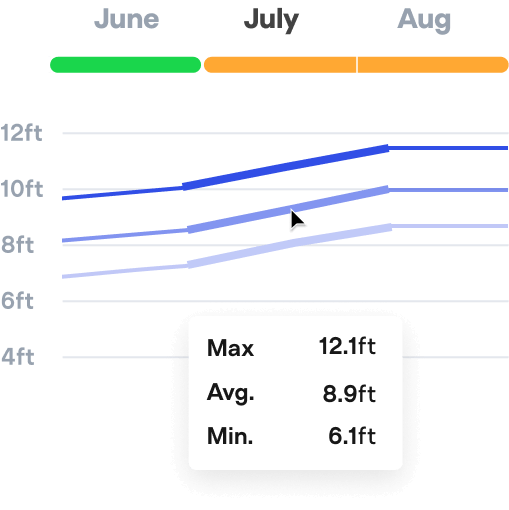
When to Score & Seasonal Surf Data
Know exactly when to score — powered by our expert historical forecast data.
Decades of spot-specific swell info — combined with forecaster insights — show your best chance to score, found only on Surfline.
Time to score

Forecaster reports

Seasonal Surf Data

South Costa Rica According To...
Leilani
McGonagle
What it takes to score in the land of *pura vida* according to one of CR's favorite daughters.
What makes south Costa Rica a special destination for surfers?
I think it’s quite a unique place. People come here and can experience waves and lineups like they’ve never experienced anywhere else in the world.
What kind of waves can visiting surfers expect?
Well, Costa Rica has a little bit of everything. From long points, to peaky A-frames, reefs and fun beachbreaks, you can kind of just pick your poison. It’s great because there really is something for everyone here.
What’s the vibe?
It’s usually pretty mellow except when people don’t respect the lineup and have bad surf etiquette, that’s when people get bummed and it’s not fun for anyone. Recently, it’s been a little more crowded with people who are visiting and learning here. There are a lot of different beginner-friendly places to surf, and it’s important to understand your level. For example, beginners probably should avoid the heavier, more premiere spots because it could be dangerous for them and others in the water.
What should surfers bring?
Standard shortboards usually are the best. Bring some extra fins. And definitely sunscreen. Also, bring your favorite granola bars for a quick and easy snack. Also people should always bring lots of respect for the locals. If they can swing it, it’s epic when people bring stuff to give back to the community.
When is the best time to score?
I’m not telling you all my secrets!
What else is there to do when you’re not surfing?
There are lots of beautiful hikes, rivers, and overall, Costa Rica is beautiful place to soak in. Also, there are tours on boats to go explore and fishing, which can be a lot of fun.
What’s your favorite local cuisine?
I love the typical Costa Rican food from the Sodas. Gallo Pinto for breakfast with avo, plátano and tortilla is my favorite.
Where can people learn to surf? Any surf schools you’d recommend?
I think the best place to learn to surf is in Jaco, Tamarindo. They have so many surf schools available.
What are some things people should be aware of when it comes to local culture and customs?
Costa Rica is pura vida, so making sure you transmit that back is the most important. If you come with respect, friendliness and you’re humble I’m sure you’ll see the best of pura vida.
Travel Essentials

Culture & customs
With dozens of pay-to-play surf camps peppered along both coasts, this politically stable surf oasis regularly accommodates an ever-growing local surf culture, hordes of visiting surfers of all levels, and countless expats who’ve settled here to live pura vida year-round.
Local scene
Compared to its northern counterparts, the Puntarenas Province is much more low-key. Don’t expect as much nightlife, shopping, or tourism infrastructure – this is a more off-the-grid experience. But Pavones still draws a crowd when it’s on, because it’s worth it. In fact, many surfers choose to set up shop in Dominical, the region’s main surf town, while waiting for a swell to light up what is arguably Costa Rica’s best surf spot.
What to bring
Outside of the dry season, it can get pretty wet, and mosquitoes abound from dawn and dusk — so bring some high-quality bug spray along with all your tropical surf trip essentials: warm-water wax, sunscreen, rashies, shades, hats, etc. If you’re staying in Pavones, keep in mind that you may not be able to find all the items that you would in more populated parts of Costa Rica. There’s a grocery store, which has the essentials, some convenience stores, and a handful of restaurants. But that’s about it. So pack accordingly.
Also: Our amazing partners over at FCS have curated a collection of fine products for your next surf trip. Check it here.
How to get there
Getting to Pavones is a schlep. Driving from the airport in San José takes about seven hours. And the roads can get a little dicey, especially during the rainy season (May-November), and as you get closer to the wave, you’ll want if not need a 4x4 vehicle. Another option is to fly from San José to Golfito Airport. From there, it’s a two-hour drive on dirt roads to Pavones. You can also fly into Puerto Jimenez Airport, then take a ferry to Golfito, then brave the two-hour drive on dirt roads to Pavones. There’s a few options, but a trek is inevitable.
Downtime
Similar to the rest of Costa Rica, the southern part of the country is rich with natural beauty, so free time is best spent exploring the outdoors. Waterfalls are abundant — including the Punta Banco waterfall, the Tiskita waterfall, and one along the Rio Claro. Wildlife spotting is another popular activity, and howler monkeys, butterflies and birds are on full display at the Piedras Blancas National Park and the Tiskita National Reserve. There’s also tours for horseback riding, fishing, ATV riding, whale watching and more.
Quick Tips
Travel Time
LAX: 6 hrs
JFK: 5 hrs
Heathrow: 11.5 hrs
SYD: 30 hrs
Connectivity
The southern region of Costa Rica’s Pacific coast is pretty dang rural. Expect limited cell service, although potential WiFi connection at hotels and other accommodations.
Currency
Costa Rican Colón. At the time of writing, $1 USD = 669.15 CRC
Avg. cost of...
Cup of coffee: $2.00
Lunch: $7.00
Beer: $3.00
Hotel room: $100.00
Visa Requirements
No visa necessary for US visitors, unless you plan to stay longer than 90 days.
Drinking water quality
In general, tap water is safe to drink in Costa Rica. However, in more rural areas – like the Caribbean side or the southern region – it’s best to stick to bottled water.
Hazards
Heavy rain, rough roads, mosquitos, petty theft, noodle legs from reeling lefthanders.
Cash, card, crypto
Although the national currency is the Costa Rica Colón, nearly everywhere accepts USD. However, in the south, don’t expect many ATMs. Get some cash before you go.


Have feedback on this zone? Let us know [email protected]
Questions about booking with Surfline Travel? Check out our FAQs