North Costa Rica
Boasting some of the country’s best and most popular surf spots, Northern Costa Rica is holding. There’s a handful of legendary, yet off-the-beaten-path, spots in the region, like Witches Rock and Ollie’s Point, which can produce some of Central America’s best righthanders on their day. Then there’s the more frequented spots, like Tamarindo and Playa Grande, which, although there may be more heads in the lineup, the waves are worth the crowd (when they’re on). And, aside from all the surfing opportunities, the north is a hotspot for nature lovers, yogis, and anyone in search of that pura vida spirit.
The Waves

Ollie's Point
With offshores funneling through the jungle, perfectly tapered rights peeling down the rock-strewn point, a grassy headland above and crystal-clear water underneath, this rivermouth/pointbreak has to be one of the more enjoyable rights in the world -- like a warm-water Rincon minus the crowd. The only problem with Ollie's Point is its narrow swell window -- it has to be a solid SW swell to even show, and even then, Witches Rock (and Tamarindo and Playa Hermosa, etc.) are generally bigger. But if you get it on a head-high to slightly overhead day, your bag of tricks will get deeper as the day goes on, as the wave is as long as it is forgiving. There are even occasional tube sections, especially when the wintertime offshore wind blows.

Witches Rock
The wave itself is no Black's or Ocean Beach or even Hossegor -- it's easy, playful beachbreak with offshore winds that sting your eyes as you start pumping down a long, groomed, green line. The estuary deposits sand on an otherwise fairly flat sandbar, creating the lefts and rights that wall up for days without necessarily closing out. There are other peaks along Playa Naranjo's two to three-mile, white-sand stretch, but they're not as perfectly shaped as the ones found in the lee of the rock.

Playa Grande
Playa Grande is one of the most consistent breaks in the region, and it often holds a lot more size than Tamarindo. This quality beachbreak is located on the north side of the river mouth from Tamarindo (about 25 minute drive/30 minute beach hike), and focuses anything from the Southern Hemi, especially South-West swells. There are outer reefs, which make low tide not ideal (close-outs mostly). Mid tide is best, offering fun A-frames, rippable rights and lefts, as well as barrels. A big high tide will often produce very annoying backwash. If everywhere else is flat, however, Playa Grande will have something to ride, and it's especially good when an off-season Southern Hemi swell combines with winter-time offshore winds. Grande is also the closest quality surfing beach to Liberia International Airport (LIR), which is about an hour's drive on all paved roads. Other spots from LIR: Reserva Conchal is a 15-minute drive; Playa Flamingo is a 25-minute trip; and Potrero is a 30-minute drive. Click here to download Surfline's North Costa Rica Surf Guide pdf.

Tamarindo
The bay of Tamarindo stretches for about four miles. There are at least four distinct surf breaks along that stretch, from north to south: 1. Playa Grande is probably the most consistent of all Tamarindo's spots. It's a cooking beachbreak, especially on a good S swell. It's a somewhat flat beach, so it has the tendency to close out at low tide, but at mid-high tide, it's all near-shore, A-frame tubes. Playa Grande is always bigger than in Tamarindo, and if it's flat everywhere else, Grande will still have something to ride. It's especially good when an off-season S combines with wintertime offshores; 2. El Estero (Tamarindo Rivermouth) isn't a classic rivermouth setup, but it's a good wave when the sand settles just right, which it can for weeks at a time. It's split between rights on the south side and lefts on the north; 3. Tamarindo Beachbreak is an average beachbreak that's never as good as Playa Grande, but it has the advantage of being right in town. There are lots of beginners here; 4. Pico Pequeno is a right lava reefbreak that can get really good -- it seems to favor a SW swell and a mid-high tide (low tide is sketchy and shallow). It's also a one-peak sort of wave, so the crowd is especially difficult.

Avellanas
About 30 minutes south of Langosta is Playa Avellanas, a series of rocky reefbreaks, beachbreaks, and another rivermouth. Avellanas can get really good -- oftentimes better than Langosta. And since Avellanas and Langosta generally pick up more swell than Tamarindo, they're worth checking out when the latter is too small.

Guiones
At Nosara's main beach of Guiones, the waves are easy and safe. Even at double-overhead, there really aren't any beatdowns to worry about: the thickest lips just give you a short spin-cycle, stuff some of that famous Guanacaste black sand into your crevices, and pop you out the back. Like many of the black-sand Costa Rican beachbreaks, Nosara can look a bit intimidating when it's overcast, bigger, and way outside -- but paddling out, you realize how easy it is to duck-dive these waves. Once on the wave, you'll realize that this place is like a skate park; enough speed and juice at good size to get you going, with minimal consequences.When it's smaller, the place erupts into a happy chaotic mess of various characters that such an easy wave attracts. Enjoy gentle takeoffs, long walls with the occasional critical lip, plenty of roundhouses and closeout rebounds. Anyone and everyone could surf this wave, and thankfully it is a big beach to spread everyone out. If you're looking for something a bit more challenging -- for an intermediate or good surfer, a few days of Guiones will get monotonous -- head north. There are a few beachbreaks lurking down dirt roads north of town that are much more hollow. Nothing death-defying, but Playa Hermosa-style barrels can be had.


Mal Pais
Tucked into the southwest tip of the rugged Nicoya Peninsula, Mal Pais (and neighboring Playa Carmen and Santa Teresa) is a popular haunt, as the surf is pretty consistent and spread out enough to accommodate a whole army of waveriders. It's all similar -- shifty A-frames with long walls that connect into inside closeouts -- though it can get bigger and hollower as you head north, especially during a S swell. Mal Pais is easy, almost California-style beachbreak -- not as heavy as Hermosa, but very fun. South of Santa Teresa, toward Cabo Blanco Nature Preserve, there are a few quirky, bigger-wave reefbreaks. Heading northward, there are some semi-secret spots waiting to be ridden.

If you want to get better in different types of waves, Costa Rica is a good place to go. There’s a lot of variation. A little bit of driving and you can find some amazing waves.

When to Score & Seasonal Surf Data
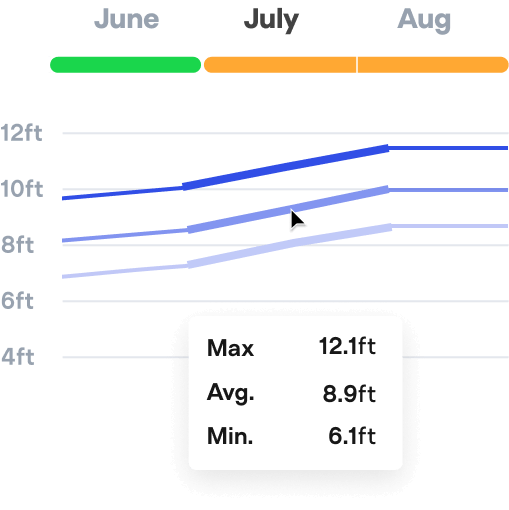
Know exactly when to score — powered by our expert historical forecast data.
Decades of spot-specific swell info — combined with forecaster insights — show your best chance to score, found only on Surfline.
Time to score

Forecaster reports
Seasonal Surf Data

North Costa Rica According To...
Carlos
Munoz
Local hero talks local vibes, variety of waves, and the Pura Vida spirit.
What makes Costa Rica a special destination for surfers?
Costa Rica is blessed on both sides, the Caribbean and the Pacific, and there’s waves all year long. Warm water, good food, very clean ocean – it’s a good place to go surf. The people are nice, they don’t want to fight with you over waves. You will connect to nature. It has a lot of good things.
What kind of waves can visiting surfers expect?
The northern part of Costa Rica is beautiful and has so many options for all kinds of surfers. You can go exploring and get into some incredible scenery and amazing beaches. There are places that are more comfortable and well-traveled for people that maybe aren't into roughing it so much. And there are all kinds of waves, from beachbreaks to reefs. There's a lot of variety in this area.
What’s the vibe?
Costa Rica is a place where there is a lot of different cultures. We have Americans, we have people from Israel, Argentina, Brazil…it’s a big mix. If you find yourself amongst the locals, they pretty much like to share. They like the good vibes. One thing that I’ve found is that when I’m around people who are learning, I get excited for them. I get excited for the moment they’re living in—when you’re standing up for the first time or turning for the first time or get your first barrel—I get excited and like to cheer for them. And I feel like most Costa Ricans are like this. We like to share and get excited and cheer when people have fun here.
What should surfers bring?
Bring three boards if you can. One epoxy, just in case you have to do some groveling. And you should bring a step-up. I think sometimes people underestimate how strong the waves get here. And then your regular board. If you can only bring two leave the epoxy at home. You should bring an umbrella in case it’s too sunny or too rainy. A lot of sunscreen. And bring the good vibes. You will find good waves, for sure.
When is the best time to score?
The Caribbean is similar to Hawaii. From December to March, you can find the storms that make the waves over there. It’s pretty heavy. It’s slabby and the energy is a lot different in the Caribbean compared to the Pacific. Also, the Caribbean has reefs, so during those months you can get some really good waves if you are in the right spot. The Caribbean and Pacific are kind of opposite—if it’s raining on the Pacific side, it will be sunny on the Caribbean side.
Then, right when it gets to March, the south swells start to hit on the Pacific side and you start getting lots of lefts. The sandbars and points get really good. When the southwests start to hit in April, May and June you probably have the best conditions on the Pacific side. The winter is a great time for learning. It’s smaller and more gentle. In the rainy season, the only thing is sometimes the water can get a little dirty and the rain doesn’t stop, but the waves are still heavy.
What else is there to do when you’re not surfing?
I just went to visit this place called Arenal for the first time in my life. Man, it’s beautiful. I couldn’t believe it. The mountains, the nature, the hot springs, the volcano…it’s a really incredible experience. There are a lot of trails to walk. You can go to national parks and look for birds and animals. Costa Rica is one of those places that has a lot of reserves, and if you like wild nature, it’s very beautiful. There are a lot of retreats where people like to have a quiet place to go and reconnect with the earth. It’s a very open place for many things.
What’s your favorite local cuisine?
You have all types of good. Gastronomy is very popular in Costa Rica. There are beautiful restaurants. I love gallo pinto. It’s rice and beans, but they have a way of cooking it that’s very good. We mainly eat that for breakfast with eggs, avocado, platano, sour cream. That’s my favorite. We also eat rice and beans with different kinds of meat and fish and vegetables. Handmade tortillas, they have a very particular way of making them. That’s pretty much the local kind of food. And we have steak and sushi and all the fancy kinds of things, too.
Where can people learn to surf?
For people that are just learning there are a lot of beachbreaks. They can be not so strong, so they are not that hard to surf and the water is warm. And with so many people coming here from all over the world, it is not hard to find somebody to teach you or a surf school to take lessons at. It’s a very gentle place to learn—just watch out for the sun. The sun is not so gentle.
What are some things people should be aware of when it comes to local culture and customs?
If you go to a new place, just try to be careful and be aware of your surroundings. You never know what the intentions are of the people around you. If you are in a place with good people, you will have a great time, but you should always be aware. Costa Rica is very safe and the people are very nice, but you never know. Other than that, enjoy it, bring good vibes, have a good time with the local people and the culture. Share some waves, and respect like always.
Travel Essentials

Culture and customs
With dozens of pay-to-play surf camps peppered along both coasts, this politically stable surf oasis regularly accommodates an ever-growing local surf culture, hordes of visiting surfers of all levels, and countless expats who’ve settled here to live pura vida year-round.
Local scene
The northern Pacific coastline of Costa Rica, also known as Guanacaste Province, is one of the most popular regions in all of Central America for traveling surfers, with the infrastructure to match: luxury resorts, boutique hotels, yoga retreats, surf camps, roadside taquerias, fancy restaurants, abundant nightlife, and more.
What to bring
Outside of the dry season (December-April) it rains almost daily here, and mosquitoes abound from dawn and dusk — so bring some high-quality bug spray along with all your tropical surf trip essentials: warm-water wax, sunscreen, rashies, shades, hats, etc. But bring a wetsuit top, too, or even a springsuit. The water can get quite cold at times due to upwelling.
Also: Our amazing partners over at FCS have curated a collection of fine products for your next surf trip. Check it here.
How to get there
When arriving at Liberia International Airport, just grab a rental car or hire a driver, then make your way to the coast. Tamarindo is a little over an hour away.
Guanacaste is for nature lovers, and there’s plenty to soak in here. In the north, a handful of national parks – including Santa Rosa National Park, Palo Verde National Park and Tenorio Volcano National Park – offer pristine beaches, dense mangrove swamps, hiking, waterfalls… Pretty much anything you’d expect to find in a coastal rainforest, you’ll find here. But if that’s not your bag, you can still dine, drink and dance to your heart’s desire down in Tamarindo.
Quick Tips
Travel Time
LAX: 6 hrs
JFK: 5 hrs
Heathrow: 11.5 hrs
SYD: 26 hrs
Connectivity
WiFi connection is expected at hotels, other accommodations, some coffee shops, etc. As far as general cellphone reception, it just depends on how far off-the-grid you decide to venture.
Currency
Costa Rican Colón. At the time of writing, $1 USD = 669.15 CRC
Avg. cost of...
Cup of coffee: $2.00
Lunch: $7.00
Beer: $3.00
Hotel room: $150.00
Visa Requirements
No visa necessary for US visitors, unless you plan to stay longer than 90 days.
Drinking water quality
In general, tap water is safe to drink in Costa Rica. However, in more rural areas – like the Caribbean side or the southern region – it’s best to stick to bottled water.
Hazards
Heavy rain, crocodiles in the lineup, rough roads, mosquitos, petty theft, board-snapping beachbreaks.
Cash, card, crypto
Although the national currency is the Costa Rica Colón, nearly everywhere accepts USD. It’s always a good idea to have some cash on you, too, so stop by an ATM when in a major city.
Explore Other Zones


Have feedback on this zone? Let us know [email protected]
Questions about booking with Surfline Travel? Check out our FAQs