Fiji
An idyllic vacation spot for anyone who values tropical beauty, the pristine barrier reefs of Fiji are primo surfing real estate. Sitting quite close to Fiji’s biggest island and hub for everything, Viti Levu, Cloudbreak and Restaurants are two of the best waves on the planet. These legendary lefts aren’t the only game in town, though -- there are breaks stretching along Viti Levu’s Coral Coast all the way to Suva, Fiji’s vibrant capital city. Bottom line: Fiji is paradise, and one of the most coveted surfing destinations in the South Pacific. You can’t lose.
The Waves

Cloudbreak
Sitting a mile south of Tavarua, the world-class lefthander named Cloudbreak is actually the eastern edge of an expansive, shallow coral reef pass that receives the undiminished force of Southern Hemisphere swells. Surfers with little travel experience should note that outer-reef waves like Cloudbreak travel much faster than their continental-land-mass counterparts, and if you don't concentrate on getting to your feet quickly, chances are that you will find yourself picking coral from your back.Despite what you may have heard, Cloudbreak can be relatively sectiony, and the lineup involves a large playing field. The swell sweeping toward the reef generally focuses on one of three general areas: the Point (aka The Top), the Middle, and the Inside (aka Shish Kabobs). Because the introductory perspective to Cloudbreak is from a boat in the channel, guests often assume that the inside is the best and safest place to park oneself because of its proximity to deeper water. The truth is that although the inside section can offer some nice tubes and can be a faster escape route to the channel, it's actually the Point and the Middle that have the more forgiving, rippable waves. The inside section is known as Shish Kabobs for a reason: a standard visitor's tax is paid in flesh to the sharp, skewer-like reef that lies just below the surface.Even for the experienced surfer, sizable Cloudbreak can represent a significantly intimidating experience. Thick, fast-moving lefts can hit different parts of the reef at a number of different angles, and it can often be a difficult task figuring out where to be to catch the best waves. Once you get it wired, a good session at Cloudbreak is nothing short of a complete barrel-fest. On fairly rare occasions, large, clean long-interval swells turn Cloudbreak into an astonishing one-section wave that breaks on a part of the reef known affectionately as the Ledge (actually the outside of the inside). If you're lucky enough to surf or simply watch this magnificent leviathan, you've witnessed one of the great wonders of the world.

Restaurants
If large Cloudbreak isn't your cup of tea, then you'll be pleased to known that Tavarua offers the best Plan B in surf travel: Restaurants. Just a relatively short, dry-hair paddle from Tavarua itself, this reefbreak got its name because you can scarf pancakes at the island's eatery while you watch your buddies get tubed out of their minds.Depending on the angle and period of the swell, Restaurant's will usually be about half the size of Cloudbreak, but what it loses in proportion, it makes up for in quality: long, sectionless lefts wrap around the reef that surrounds the western side of Tavarua and push off at such an ideal speed and uniformity that it produces one of the most flattering rides on the planet.But before you go trying an alley-oop after your 20th five-second tube in a row, remember that Restaurant's does have another potentially negative feature: the reef. What can only be described as a briar patch of sharp coral trees awaits the unsuspecting surfer who gets a little too bold or hasn't properly consulted a tide chart (low tide can be bad news if the swell isn't strong enough). More than one famous surfer has been helplessly stuck just inside the impact zone with his leash wrapped around coral heads as wave after wave pounds him to submission.
Wilkes Pass
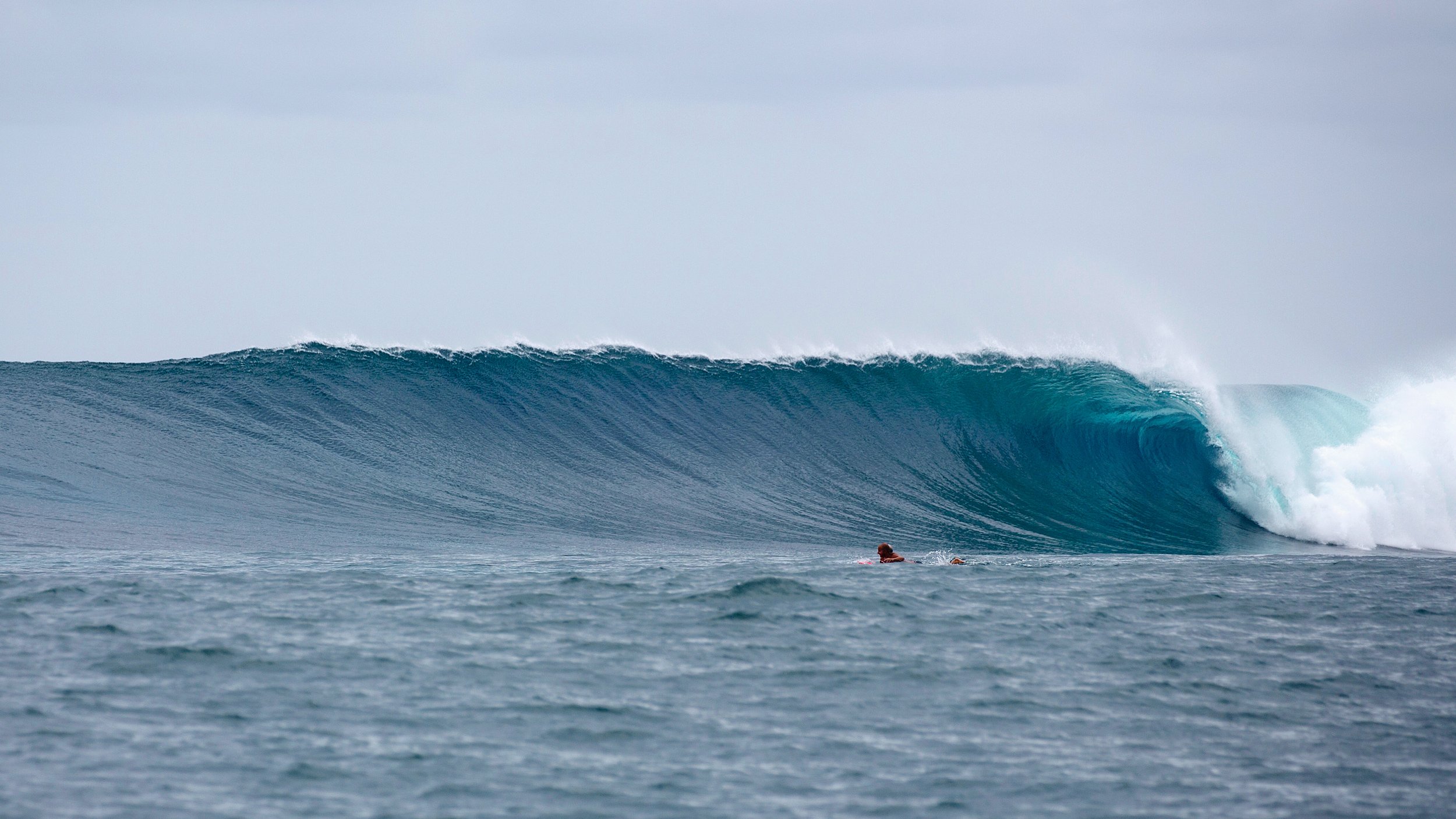
Breaking around the southern tip of a barrier reef located to the northwest of Namotu Island, Wilkes Pass is a powerful, lengthy right-hander that is open to virtually all swell and wind, making it consistent but somewhat fickle. One of the longer waves in Fiji, Wilkes starts with a relatively standard takeoff, proceeds through a number of stretched out sections, and ends in a shallow bowl section. Tends to be a few feet bigger than Swimming Pools and Namotu Left due to its exposure to swell.

Namotu Left
This lefthander is a fun, playful wave suitable to most surfers' abilities - rather short and sometimes sectiony, but well worth it. Located across the channel from Wilkes Pass, of course, when the swell gets big, this wave gets much heavier, but it is still nothing like Cloudbreak or Restaurants.

Frigate Pass
One of Fiji's most famous waves, and also one of the gnarliest, this is the sort of reef pass that if you showed up on the wrong day, you would question its designation as an actual surf spot. Considered to be the Coral Coast's answer to Cloudbreak, Frigate Pass receives oodles of unblemished open-ocean swell, so it is rarely flat, but it does get too big as to be unsurfable for most. Basically Frigates is a heavy lefthand barrel, fairly long and usually makeable, bending into the shallow pass. The waves just pop out of very deep water and hit the reef. It's rather playful when small or medium-sized; bigger than six or eight-feet is when it gets serious.


We have such beautiful reefbreaks, and sharing waves with a smiling Fijian and feeling welcome, I think that’s something that makes Fiji unique. It’s a special place.

When to Score & Seasonal Surf Data
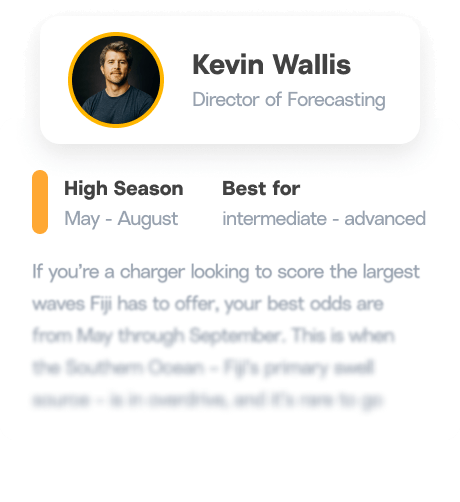
Know exactly when to score — powered by our expert historical forecast data.
Decades of spot-specific swell info — combined with forecaster insights — show your best chance to score, found only on Surfline.
Time to score

Forecaster reports
Seasonal Surf Data

Fiji According To...
Inia
Nakalevu
Get to know the modern Fijian surf scene through the eyes of a local charger.
What makes Fiji a special destination for surfers?
We have such beautiful reefbreaks, and sharing waves with a smiling Fijian and feeling welcome, I think that’s something that makes Fiji unique. It’s a special place.
What kind of waves can visiting surfers expect?
We have a lot of options. People come to Fiji and they have all sorts of different levels of surfing, and we do have Cloudbreak, which is the most famous and biggest and heaviest wave, but we have options for everyone from beginners to pros. Fiji is all reef breaks. We only have one beachbreak, which is Sigatoka, a rivermouth.
What’s the vibe?
The vibes in Fiji are always good. Nobody’s really territorial. The locals like to share the waves with everyone. Fiji is a very happy, welcoming place, especially when you act the same way.
What should surfers bring?
Bring booties or reef shoes, that helps a lot of people. Sunscreen is a must. Lots of sunscreen. Hats and sunglasses, too. You can bring a wetsuit, but it’s summer year round in Fiji, even in winter. But sometimes a wetsuit top or spring suit is nice to have. As far as surfboards, for experienced surfers bring your normal shortboard and two step-ups, especially during winter when we have the big waves out at Cloudbreak. For intermediate surfers, bring a board with a little more volume. It’ll help you to catch the wave easier and paddle in the current. A bigger board will help on high tide and when there’s wind coming up the face.
When is the best time to score?
From the end of March through July and August is a good time. The trades can start to pick up in July, but sometimes we have no wind at all and there’s plenty of swell.
What else is there to do when you’re not surfing?
There’s a lot to do on the land. There are waterfalls to check out. You should check out the Sleeping Giant Garden, it’s nice and cool to walk around in. There are hot springs and mud pools that are worth checking out. It’s about 30 minutes outside of Nadi.
What’s your favorite local cuisine?
I love eating Kokoda, which is a raw fish recipe mixed with coconut milk. Also lovo, which is underground cooking. We cook pigs like this, sometimes fish. We can cook anything this way. And roro is really good, it’s made with taro leaves and coconut milk.
Any other local tips?
When you go to visit the local villages it would be nice to show respect by taking your hats off. Men should wear a sarong. The ladies should wear a dress or something. When you come to the village, you can bring kava root. Go to the market and get one or two kilos and bring it to the village for what we call a savusavu. It’s a good way to say thanks and show your appreciation for being in Fiji.
Travel Essentials

Culture & customs
The Fijian people are known worldwide for their warmth, openheartedness and cheerfulness. You’ll hear a lot of Bula!, which is like the Fijian version of Aloha and reflects the welcoming spirit of the people. (The longer version of the greeting — ni sa bula vinaka —translates to “wishing you happiness and good health.”)
Local Scene
Before the reefs at Cloudbreak, Restaurants and The Right were opened to the public, these legendary waves were some of the most exclusive in the world, reserved for paying guests of Tavarua. The Fijian government has since issued a decree to open them to all surfers, but there’s a catch: you still need to figure out the 30-minute boat ride from the main island. Most traveling surfers fly to Fiji during peak season (May-September). That’s when the main breaks will see an abundance of local and visiting surfers, but with the right wind conditions, other spots can be good and relatively uncrowded.
What to bring
There are waves for every type of surfer in Fiji, but the marquee spots -- Cloudbreak, Restaurants, The Right — cater to the high-performance shortboard crowd. So, if that’s your vibe and skill level, be sure to pack the fastest, most agile boards you’ve got, as well as a step-up for when it gets heavy. Bring all your tropical surf trip essentials, naturally, as well as t-shirts, hats and other swag to stoke out the locals and return their kindness and generosity.
Also: Our amazing partners over at FCS have curated a collection of fine products for your next surf trip. Check it here.
How to get there
Once you arrive at Nadi International Airport on the main island of Fiji, you’ll need to drive or take a shuttle to your hotel, surf camp or resort. For those staying on Tavarua or Namotu, you’ll take a 45-minute shuttle to the boat launch. From there, it’s a 30-minute boat ride to either island.
Downtime
Fiji’s a tropical paradise. When you’re not surfing you can fish, dive, stroll along the beach, climb coconut trees, lounge by a pool with umbrella drink in hand or crack open a good book. Chances are, though, the world-class waves will be enough for you. If not, there's always the world-famous Cloud 9 floating bar & restaurant. It’s anchored in the ocean and serves perhaps the most Instagramable cocktails on Earth.
Quick Tips
Travel Time
LAX: 11.5 hrs
JFK: 16.5 hrs
Heathrow: 21 hrs
SYD: 4 hrs
Connectivity
Expect WiFi connection at your resort. Other than that, you’re on your own.
Currency
Fijian Dollar. At the time of writing, $1 USD = 2.16 FJD
Avg. cost of...
Cup of coffee: $3.00
Lunch: $10.00
Beer: $4.00
Hotel room: $250.00
Visa Requirements
No visa necessary for US visitors, unless you plan to stay longer than four months.
Drinking water quality
Tap water is safe to drink where filtration is in place, like in cities and resorts. However, bottled water is never a bad call.
Hazards
Sunburns, surfing yourself into a coma or, conversely, having a few too many umbrella drinks and missing out on a session or two.
Cash, card, crypto
You probably won’t have much need for spending cash as you’ll likely be spending most of your time at a resort. But having some hard dollars on you for tipping is always recommended.
Explore Other Zones


Have feedback on this zone? Let us know [email protected]
Questions about booking with Surfline Travel? Check out our FAQs