Central California
With a rugged, frontier feel compared to the bustle of SoCal, Central California delivers raw coastal beauty and powerful, swell-exposed surf. From the cobblestone points around Morro Bay to the punchy beach breaks of Pismo and the reefs of Big Sur, this stretch of coastline is as scenic as it is challenging (and sharky).
The Waves

Moss Landing
One of California's best beachbreaks. During the winter, when a W swell is filling the bay and the offshores are howling out of the Salinas Valley, Moss Landing will take your breath away, in more ways than one. Just offshore, hidden under all that water, the Monterey Canyon drops down to a maximum depth of over a mile, and the Canyon has an effect on what happens along the beach. The swell that hits Moss Landing has come out of very, very deep water and hasn't been slowed down by the continental shelf. The result is a very powerful, often frustrating, beachbreak. It can be almost impossible to get out at Moss Landing, and there is always the possibility of getting hammered by a triple-overhead wave.In the winter, Moss Landing is a very serious surf spot -- big, powerful and challenging. The surf mellows the closer you go to the jetty to the south, and it gets gnarlier as you go north, toward the dunes. There also is surf on the other side of the harbor, in front of the Moss Landing Marine Lab and the Monterey Bay Aquarium Research Institute.

Carmel
One of the prettiest beaches in the world. The sand at Carmel Beach is fine and white and squeaky clean, and sometimes the surf is, too. There are peaks all along this half-mile beach, which change constantly and are best from October to July. The spots are 4th Street, 8th Street and 11th Street. The water is electric blue. Carmel Beach is hit or miss. The kelp and cove protect it from winds, so it can be offshore when everywhere else is blown out. Every now and then, there are serious tubes to be had. It's all just a matter of looking.

Sand Dollar
A glistening crescent of pure, white sand yawning into a horseshoe cove of shifty sandbars, sheltered from N and S wind and rather user-friendly, Sand Dollar is a delightful pocket for just about anybody, thanks to the gently undulating beach and forgiving whitewater rollers on the inside. The south end of the beach is usually a long, mushy left which dissolves into the channel in the middle of the cove. The rights are speedier, shallower, shorter, bowlier and much more walled. The cove's north end is predominantly a right that also fades into the channel, but it's usually larger and not as shapely as the south peak. The waves here are not as thick and beefy as those found down at Willow Creek.

Cayucos
Cayucos, a quaint seaside hamlet plopped down along Highway 1 between the relative metropolis of Morro Bay and the glistening greens of Harmony (population 18), was rated last year by Men's Journal magazine as one of its 25 favorite "hideouts and secret spots." Cayucos (an Aleutian word for "kayak" or "canoe," pronounced ky-YOO-cuss) was first settled as Cass Landing, after New Englander Captain James Cass stuck down his roots in 1867. He and his bros built the 953-foot-long pier, which has since provided countless days of rideable waves for the community's ever-increasing number of surfers.The Cayucos Pier was first brought to life for the surfing world through a 1982 surf magazine article. While the article explained the overall adversity of the area, the accompanying photographs portrayed the pier's wave to be a crispy, clean, green and predominantly right-hand barrel polished by icy offshores. Newsflash! The photos lie.Cayucos Pier is essentially a hollow closeout, but that's certainly not to say you won't/can't stumble upon some peelers off the pilings. A long-standing affiliate of the Central Coast's exclusive Fickle Spot Club (FSC), the Cayucos Pier is definitely lousy more often than not, but one noteworthy aspect is that the place is sheltered from the prevailing northerly winds, deeming Cayucos a bit warmer than surrounding area.This means, of course, that it's more conducive to tourists and fair-weather surfers, most of whom still wax the bottom of their boards. There are some young rippers, so don't be shocked if you see some kid boosting fat air off the end sections. All said, Cayucos Pier is a decent spot to ride some waves along the Central Coast, but don't go in expecting Huntington Beach or even Pismo.

Morro Bay
The northernmost of the volcanic peaks spanning from the city of San Luis Obispo to Morro Bay, 576-foot-tall Morro Rock (also called the Gibraltar of the Pacific) exists in a state preserve for the nesting of the endangered peregrine falcon - so surfing on the rock's north side is the closest you'll ever come to this intriguing monolith. Because the beach faces due west, any and every kind of swell hits the sandbars of Morro Rock, occasionally converting an ordinary California beachbreak into a magical mile or two of feathering A-frames and vomiting tubes. But on a daily basis, this is simply another generic beachbreak with customary closeouts, rip currents and the failure to handle anything over six-feet. The farther up the beach you go, the bigger and beefier the waves become. There's a mushy left off the rock itself, but if you crave power and consistency, you'll scarcely be disappointed with the beach's north end. If the sandbars are formed just right, they'll manage big swells. The problem then becomes making it out.

Pismo Beach
One of the more consistent and shapely of all Central Coast beachbreaks, the Pismo Beach Pier is the hub of South County surfing. At 1,250 feet long, the pier itself is lit at night, meaning full-moon sessions are a possibility. Cradled in the lee of Point San Luis and San Luis Obispo Bay, the Pier is in a slight northwest swell shadow, so it's usually smaller and less windy than the more exposed sandbars down around Oceano, but bigger than the Avila Beach area to the north.Pismo's south side is usually better than the north. Surfers are liberated to snuff out several miles' worth of white-sand beachbreak guaranteed to be devoid of others, but the pier vicinity is the hotbed. Juicy rights sometimes form off the south side, but it can be more walled. Bigger, solid groundswells are especially shapeless, so it's best to show up during a peaky windswell or a small groundswell in times of light wind and high tide. Since the beach faces southwest, playful summertime swells are desired. The beach slopes gently out from the water's edge, which also means the waves are much softer than, say, Jalama Beach or Morro Rock.

“You can pretty much find any kind of wave around here. You can drive 20 miles and find giant slab barrels, you can find long point breaks, beach breaks; just anything.”
When to Score & Seasonal Surf Data
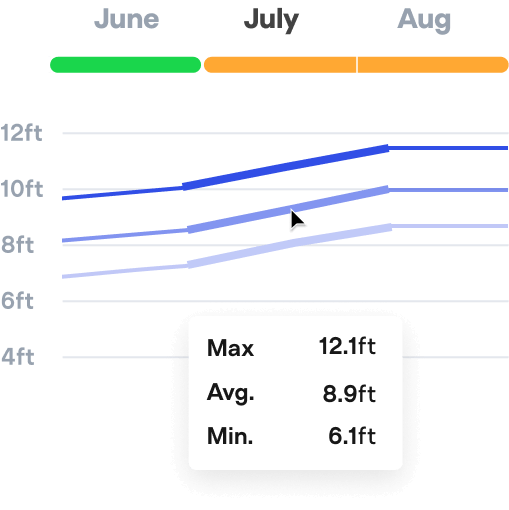
Know exactly when to score — powered by our expert historical forecast data.
Decades of spot-specific swell info — combined with forecaster insights — show your best chance to score, found only on Surfline.
Time to score

Forecaster reports
Seasonal Surf Data

California's Central Coast, According to...
Tyler
Balsillie
Local lifeguard/big-wave charger on his home turf
What makes Central California a special destination for surfers?
I’d say one of the main things is the wind. The wind stays pretty mellow, and our coast gets both north and south swells. So, no matter what swell comes in, or where it’s coming from, you usually get hit. We get our south swells in the summertime, which will make certain waves crank, and then there’s certain waves that get the north swells. So, either way, you’re pretty much getting decent waves year-round.
What kind of waves can visiting surfers expect?
You can pretty much find any kind of wave. You can drive 20 miles and find giant slab barrels, you can find long pointbreaks, beachbreaks; just anything. But I’d say the majority of the waves are going to be beachbreaks, more of a slabby break that starts off as a little pit, and then kind of mushes out, so you can get your turns in, too.
What’s the vibe?
It obviously depends where you go, but the vibe can be pretty gnarly. There’s a lot of localism here, but it’s not too crowded. If you walk down the beach, you can kind of find your own spot where nobody’s out, and you won’t get hassled. But a lot of the reef breaks are pretty localized. Don’t show up with 5 people and paddle to the peak.
What should surfers bring?
It depends who you are, but I usually ride maybe a 5’8” to 6’0” when it’s slabby. Bring a thick leash. Waves can definitely double in size when you’re out there when a swell’s about to come in. Fins setup, go quad. A lot of these waves are runners, so it’s going to be fast, and you just want something fast that you can outrun the wave with. For wetsuits, I would go no less than 4/3. Lotta guys wear a 5/4. I would definitely wear booties. Sometimes in the winter, you could wear gloves. It gets pretty cold, especially in the mornings.
When is the best time to score?
I would say summertime on the south swells. You could go wintertime, but a lot of the time it’s going to be so big, it’ll be overloading and closing out. But the souths are definitely a lot better down here. Unless you’re a big-wave surfer. But if you’re just longboarding or shortboarding, the souths are what you’re chasing.
What else is there to do when you’re not surfing?
There’s mountain-biking if you’re into action sports. There’s downtown San Luis Obispo, if you want to go out and drink or something. There’s a lot of hiking out here. There’s Madonna Mountain, Bishop Mountain. There’s some pretty cool beaches, too, like some secret beaches with not a lot of people around.
What’s your favorite local food?
Either all-you-can-eat sushi at Sushi 805, or Taco de Mexico in Morro Bay. It’s either one of those two, every time.
Where would someone go to learn how to surf?
The main learner waves are Pismo Beach and Morro Bay. Those are the two spots for the beginners.
What should visitors know about the local culture?
Just be respectful. Don’t show up with too many people. I would say, two, max. They’re kind of big on that. Don’t pound it to the peak. If it’s a reefbreak, just be careful. There’s a rule where you suit up at the beach rather than on the road, so people don’t see that there’s a wave there. But besides that, you should be fine. It can get rough, but the main thing I would say to worry about is the sharks. There’s a lot of sharks here...
Travel Essentials
Culture and Customs
Central California has a surf legacy built by surfers and shapers who leaned into its rugged coastline and relative isolation. In the ’60s and ’70s, shapers like those based in San Luis Obispo and Morro Bay (like Jerry Grantham in Pismo Bay) helped establish board building and local surf shops as cornerstones of the scene. Chad Kaimanu Jackson, from Cayucos, carries on that tradition from his father Bruce Jackson, who began shaping some of the first boards in Cayucos in the early ’70s. Pros like Nate Tyler grew up riding waves around Cambria and became known nationally, showing that this region produces surfers who can perform anywhere. While this coastline may never get the fame of Malibu or Santa Cruz, its waves and its people have quietly shaped what’s possible when surfers lean into nature, craftsmanship, and perseverance.
Local Scene
The Central Coast has a way of pulling surfers in who want surf without the crowds and traffic of SoCal, but still get legit waves on hand. Breaks around Morro Bay, Cayucos, Pismo, and beyond offer a mix of mellow beachbreaks and slabs depending on swell and sand. Some days it’s longboard friendly, others calling for your most high performance shortboard. Localism is definitely a thing here, but the larger towns will see a type of balance of Cal Poly students with local, generational families. Winters bring powerful NW swells, but wind and chop can mess things up midday, while summer usually gives fun, forgiving surf, so knowing tides and wind windows is key. For many surfers, the vibe is about exploring, though, finding that less-obvious peak, and being part of a small community that treasures surf more than status or scene.
What to bring
Shortboards, step-ups during wintertime, fishes, twinnies, even longboards — there’s a wave for every style of surfer. Rubber-wise, a 4/3mm w/ boots will get you through summer, while a hooded 5/4/3 with boots and gloves are what you’ll need for winter.
How to get there
There’s no easy, straightforward way to get here. You fly into LAX and then it’s a 3.5-hour drive north in. You fly into San Francisco, and it’s a 3-hour drive south. If you’re rich, you can fly into SLO, but not internationally.
Downtime
Central California offers a laid-back blend of outdoor adventure, scenic beauty, and small-town charm. For action seekers, there’s world-class mountain biking and hiking, with trails up Madonna Mountain, Bishop Peak, and Montaña de Oro State Park. Downtown San Luis Obispo brings the energy at night, with bars, breweries, and live music, while nearby Paso Robles is famous for its wineries and tasting rooms. Along the coast, mellow beaches and tucked-away coves provide plenty of space to escape the crowds, and spots like Morro Bay and Pismo Beach add their own seaside character. Whether you’re chasing solitude in nature, sipping wine in the hills, or strolling the quirky shops of SLO, the region has something for everyone.
Quick Tips
Travel Time
JFK: 10 hours
Heathrow: 15 hours
Sydney: 17 hours
Connectivity
Most everywhere, unless you're really exploring.
Currency
USD.
Avg. cost of...
Coffee: $6.00
Lunch: $20.00
Beer: $8.00
Hotel room: $250
Visa Requirements
Yes. Depends where you're coming from. Check with your local consulate.
Drinking water quality
Fine.
Hazards
Sharks, locals, shallow reefs, closeouts, road closures adding time to the journey
Cash, card, crypto
Credit cards are widely accepted, and access to ATMs is readily available.
Explore Other Zones


Have feedback on this zone? Let us know [email protected]
Questions about booking with Surfline Travel? Check out our FAQs